
Structured extraction · Narrative → JSON · Showcase 3
Narrative in, JSON out: a 1.5B accident-report extractor that knows when to say null
Our first two showcases were a
span tagger
and a passage reader
that answers questions. This one is neither. It reads a U.S. aviation accident narrative
and writes one flat JSON record: aircraft, damage, injuries, operating rule, flight
purpose, date, state and pilot hours. When the narrative doesn't state a field, it writes
null instead of guessing. On 1,234 test narratives fixed before any model
was scored, it gets 0.959 of fields exactly right, against 0.494 for the same base model.
When a field isn't in the text, it leaves it null 97.6% of the time, against 54.5%. All
three training seeds passed the rule we wrote down first. It is
on the Hugging Face Hub.
For education only. The model in this post demonstrates a training method. It is not an aviation-safety or accident-investigation expert and makes no claim to be one. It misses about half the aircraft model designators the narratives state (see below). Its output is not an NTSB finding. For anything real, use the official records at data.ntsb.gov.
The result, in one table
1,234 held-out test narratives. Every output is parsed as JSON and compared field by field
with the answer key. The comparison is typed: numbers as numbers, strings ignoring case
and spacing, and null, a missing key and "" all count as null.
| Base model, same prompt | Base model, schema-aware prompt* | Fine-tuned (seed 42, published) | |
|---|---|---|---|
| Output matches the schema (valid JSON, every field, right types, allowed values) | 0.042 | 0.770 | 0.995 |
| Fields exactly right (13 fields, all rows) | 0.494 | 0.481 | 0.959 |
| Whole record right (all 13 fields) | 0.000 | — | 0.625 |
| When it says null, the field really is unstated (null precision) | 0.901 | 0.533 | 0.954 |
| When a field is unstated, it says null (null recall) | 0.545 | 0.371 | 0.976 |
* A 300-row subset of the same test set, run by a separate script and scored with
BrewSLM's own scorer. It gives the base model its chat template, every field's type and
allowed values, and "use null when the narrative doesn't state it". We ran it so the
fine-tune couldn't be credited with what a better prompt would have done anyway. Prompting
fixed the format (0.042 → 0.770 schema-valid), but accuracy didn't move, and the base model
started inventing: guessed dates, "Not specified in the narrative" as an
aircraft make, values for fields the text never mentions. Null recall fell, from
0.545 to 0.371. Telling a small model "don't guess" isn't the same as teaching it not to.
Why this task, and why null is the point
Extraction is the most common thing people want a small model for that isn't chat: read a document, fill in a form. The NTSB's accident database is a good test bed. It's public domain, it's large, and every event has both a narrative written by an investigator and a set of coded fields filled in by hand. That looks like a ready-made answer key. It isn't, and that's what this project was about.
The coded fields come from the whole investigation: forms, records, interviews. The narrative is a summary, and it often doesn't repeat them. In the 12,421 events we used, the narrative names the aircraft make in 40% of cases and states the pilot's total hours in 7%. Train a model to output the coded value from the narrative, and for those rows you are training it to produce a fact that isn't in its input. That is invention, taught on purpose. A model trained that way will fill in the pilot's hours for any narrative you give it.
So the answer key is masked. For each field we start from the
investigators' coded value, and keep it only if a fixed, deterministic text check finds it
stated in the narrative. Otherwise it's null. The make or model has to appear
as written. The injury counts have to be stated. The date has to appear in the text: when
the text's date is a day off the coded one, the text wins, because the model can only learn
to read what's there. No language model touched the labels, training or test. The masking
script went through three rounds of fixes on a 50-row hand audit. Its first version, for
example, accepted the bare word "air" as a mention of the make Air Tractor.
That gives the score a specific meaning. It measures extracts what the text says, not knows what happened. It is also slightly conservative. A check can miss a value phrased in an unusual way, and the model is then marked wrong for extracting it.
The rule, written down first
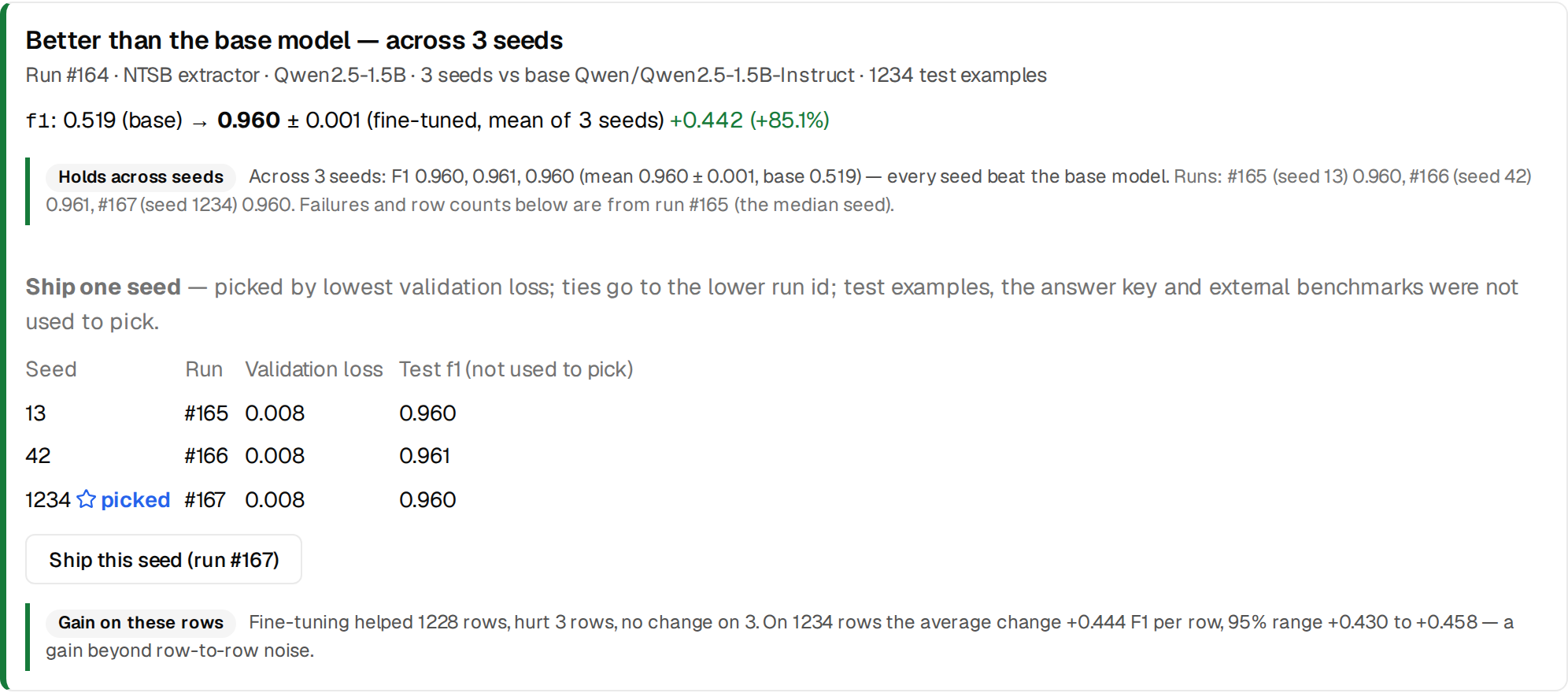
Before training we froze the rule and a checksum of it. Three seeds (13, 42, 1234) train on identical data. Each seed is evaluated on test once, and every gate must pass on every seed:
| Gate (test) | Floor | Base | Seed 13 | Seed 42 | Seed 1234 |
|---|---|---|---|---|---|
| Output matches the schema | ≥ 0.95 | 0.042 | 0.994 | 0.995 | 0.997 |
| Fields exactly right, all 13 | ≥ 0.85 | 0.494 | 0.958 | 0.959 | 0.957 |
| Weakest of the 8 fact fields, exactly right | ≥ 0.70 | — | 0.749 | 0.752 | 0.742 |
| Null precision | ≥ 0.95 | 0.901 | 0.955 | 0.954 | 0.952 |
| Null recall | ≥ 0.90 | 0.545 | 0.976 | 0.976 | 0.977 |
| Weakest of the 8 fact fields, null recall | ≥ 0.80 | — | 0.964 | 0.964 | 0.964 |
| Paired per-row gain over base, 95% interval | > 0 | — | +0.430 to +0.458 | +0.430 to +0.458 | +0.429 to +0.457 |
- The 8 fact fields are the ones a narrative states directly: make, model, date, state, the three injury counts and pilot hours. The other five (aircraft category, damage, highest injury, operating rule, flight purpose) map free wording onto fixed codes. We report them but didn't gate them per field. We couldn't justify a floor for them before seeing a trained model.
- Null recall matters most for safety. For an extractor, the harmful mistake is inventing a value the text never states. Under a masked answer key, that's exactly what null recall measures, so it has two floors.
- The rule was amended twice, before any evaluation ran. The per-row gain uses per-row field F1, because BrewSLM's evals store that per row but not per-row exact match. And we hadn't said which seed to publish, so we fixed it as the best on validation. Both changes are in the frozen file with their dates.
- One test look means one. BrewSLM runs an automatic 100-row test check after every training run. We turned it off for this project, so each seed's single full test eval is the only time test was scored.
Validation scores were 0.9595, 0.9614 and 0.9610 for seeds 13, 42 and 1234, so seed 42 is the published one. All three seeds passed every gate. Pass. The seeds agree to within 0.002 on field accuracy, so this isn't a lucky draw.
Where it still fails
| Field | Exactly right, all rows | Right when the text states it (rows) | Null recall |
|---|---|---|---|
| aircraft_model | 0.752 | 0.388 (454) | 0.964 |
| pilot_total_hours | 0.970 | 0.765 (85) | 0.985 |
| aircraft_make | 0.917 | 0.811 (508) | 0.992 |
| damage | 0.977 | 0.990 (1,155) | 0.785 |
| the other 9 fields | 0.960 to 0.994 | 0.975 to 0.996 | 0.946 to 0.991 (category: 0.571, 14 rows) |
-
Aircraft model is the big miss. 454 test narratives state the model
designator. The model returned
nullfor 232 of them and a different designator for 46. "Beech 58", "Bell 47-G", "Cessna 152": it gets the make and drops the model. Most of the gap between 0.959 field accuracy and 0.625 whole-record accuracy is this one field. If you need the model designator, check its nulls against the text. -
Its mistakes lean toward null. Across all fields it wrote
nullfor a stated value 382 times, and invented a value for an unstated field 192 times. For an extractor that's the safer direction, but it's why null precision (0.954) only just clears its floor of 0.95. About 1 in 22 nulls hides a value the text does state. - The answer key's own blind spots. Some of those "missed" models may be the masking check's fault, not the model's: if training rows nulled designators the check failed to recognise, the model learned some of that caution. We didn't measure how much. It's the first thing to look at for a v2.
What BrewSLM needed for this
Three things BrewSLM couldn't do at the start, each built as a general feature rather than for NTSB:
-
A JSON-extraction recipe with typed scoring. Extraction used to be
scored by comparing each field as a string, with no idea of types, nulls or allowed
values. The new
json-extractionrecipe takes an output schema (types, enums, nullable fields) and scores against it. Numbers compare as numbers. Null precision and recall are computed per field. Out-of-vocabulary enum values and type violations get their own rates. "Valid JSON" and "valid against the schema" are separate numbers, as the first table shows they should be. The Data step has a schema editor, and Results shows the per-field table. - Bring your own train / validation / test. BrewSLM always split a dataset itself. Here the split had to be by NTSB event id, decided outside, with 1,234 test rows fixed in advance. Use my own train / val / test files on the Data split form imports three files with exact membership: no shuffle, no ratio, no dedup. It refuses (or, if you ask, drops from train) any training row whose input also appears in validation or test. It reports rejected rows by file and line, and no later step (cleaning, synthetic data, re-splitting) can move a test row into training. That last guarantee took several rounds of independent code review to get right. Round after round found another way a test row could leak back in: a re-split, a malformed line, a column that looked like the input but was really the label.
-
Rows whose input is their own answer. One of those reviews found that a
badly mapped dataset could train a model on
input = labeland look perfect. BrewSLM now rejects such rows by name (input_is_answer,classification_input_is_label) instead of training on them, in the import and in the normal split.
Training
| Stage | What came out |
|---|---|
| Population | NTSB accidents since 2015, one aircraft, with a probable-cause narrative under 14,000 characters: 12,421 events |
| Split, by a hash of the event id | 9,931 train / 1,256 validation / 1,234 test; the import found 0 shared inputs and 0 duplicates |
| Prompt | The field list, "reply with a single JSON object", the narrative. No chat template. Longest row 3,366 tokens. |
| Training, per seed | Qwen2.5-1.5B-Instruct, LoRA r 16 on every linear layer, loss on the JSON answer only, max length 4,096 (nothing truncated), 1 epoch, 621 steps, about 4 hours on an NVIDIA GB10 |
| Final loss (seed 42) | train 0.009, validation 0.008 |
One seed didn't start cleanly. Seed 1234 failed two minutes in, before its first training step, on a DNS error reaching the model hub. No eval had run, so we restarted it with the same config. We mention it because the run log shows a FAILED row, and it should.
Try it
The model is
TensorGreed/brewslm-ntsb-accident-extractor
(Apache 2.0, merged weights, about 3 GB). Its card has the exact prompt, a working
transformers snippet, the schema with every allowed value, and every number
above. Before publishing, we re-ran that snippet against the merged weights on 100 test
narratives. It parsed all 100 outputs and scored 0.976 field accuracy on that sample.
The same run from a script
Against a running BrewSLM, the whole project is a handful of requests:
# recipe + output schema (types, enums, nullable fields)
PUT  /api/projects/{id}/recipe                 {"recipe_id": "json-extraction"}
PUT  /api/projects/{id}/recipe/output-schema   {"output_schema": { ...13 properties... }}
# your own splits, exact membership; refuse any train row that leaks into val/test
POST /api/projects/{id}/dataset/predefined-split   train=@train.jsonl val=@val.jsonl test=@test.jsonl on_leak=fail
# three seeds of one config, as a seed group
POST /api/projects/{id}/training/experiments   {"name": "...", "config": {
  "base_model": "Qwen/Qwen2.5-1.5B-Instruct", "use_lora": true,
  "max_seq_length": 4096, "seeds": [13, 42, 1234]}}
# one full held-out eval per seed, greedy
POST /api/projects/{id}/evaluation/run-heldout?async_job=true   {"experiment_id": {run},
  "dataset_name": "test", "max_samples": 5000, "max_new_tokens": 512, "temperature": 0}
The NTSB data is U.S. government work in the public domain. Courtesy: National Transportation Safety Board. The answer key is a masked derivative of the NTSB's coded fields, not NTSB findings, and this project isn't affiliated with or endorsed by the NTSB. NTSB accident reports can't be used as evidence in a civil action for damages (49 U.S.C. § 1154(b)), and nor should a model trained on them.