
Build a SQL injection classifier with a small language model
By the end of this tutorial you'll have a binary classifier that flags SQL-injection-shaped queries at sub-10ms latency, deployable inline before your database layer. It runs on a single small GPU (or CPU), costs nothing per query at inference, and — unlike a regex stack — generalises to injection patterns it has never seen because it's a language model, not a string matcher.
Before you start
This tutorial assumes BrewSLM is running locally at http://localhost:5173 with an admin user signed in. If you haven't done that yet, complete Tutorial 0 — Set up BrewSLM and your first project first. It takes ~15 minutes and is the prerequisite for every tutorial in this track.
You'll also want, before you start: ~100 injection samples (the OWASP / payloadbox payload list is fine) and ~200+ benign queries mined from your own application logs. The benign queries are the harder part to get right — that's the work this tutorial focuses on.
Terms you'll see in this tutorial (click to expand)
- Recipe
- The training-plan template behind a project. For this tutorial:
classification(shown in the app as the task type Text Classifier / Classification). Defines the base model + adapter + pass/fail-rule defaults for binary/multi-class text classification. - Answer key
- BrewSLM's name for the gold set — the trusted, human-checked rows every run is scored against. It lives under Data → Labels (the Answer key card). This tutorial says "answer key" for the thing in the app and "gold" for the idea.
- Classification head
- A small dense layer the platform adds on top of the base model's hidden state to predict a label from a fixed vocabulary. For SQLi: two output classes (
injection,benign). - Hard negative
- An input that LOOKS like the target class but is labeled as the OTHER class. For SQLi: a benign query that contains injection-flavoured tokens (quote marks, OR, comments, SELECT). The single most important data type for a security classifier.
- HARD_NEGATIVES playbook
- BrewSLM's synth generator for confusable rows. Asks a teacher model to generate inputs that look like the target class but should be labeled as the other class. The classifier's precision lives or dies on the rows from this playbook.
- Macro-F1 / per-class precision floor
- Eval gates that catch class-starving failure modes. Macro-F1 averages per-class F1 equally (no majority-class bias). Per-class precision floor requires every class to hit a precision threshold individually — for SQLi you'll override the default to 0.95 on the benign class.
- Adversarial test set
- A small (~50 row) held-out test dataset the model never sees during training, filled with intentionally-hard inputs (obfuscated injections, unicode tricks, WAF-bypass patterns). Tests generalisation, not memorisation.
- Stratified split
- Train/val/test split that preserves the per-class ratio across all three sets. Essential when classes are imbalanced — random split can produce val sets with no minority-class examples.
- Shadow mode
- Deployment pattern where the classifier runs in production but its verdict is logged-only, not acted-on. Used to measure real-world false-positive rate before wiring the classifier to block.
This is BrewSLM's canonical workflow for a binary classifier deployed inline as a security control. The use case is SQL injection but the recipe shape generalises: command injection, XSS payloads, prompt-injection on LLM inputs, suspicious file uploads, abuse-language flagging — anything where you need a fast yes/no on a piece of text before letting it through. The bones are the same; only your gold set changes.
The end state is the model you'd actually run in production at a B2B SaaS: small enough to deploy in front of every database call without adding network hops, accurate enough to catch novel injection variants, and honest enough about false-positive cost that legitimate dynamic SQL doesn't get blocked.
What you'll build
A binary text classifier with two output labels:
injection— the input looks like an attempt to manipulate the SQL query (union-based, boolean-blind, time-blind, stacked queries, comment-leak, …).benign— the input is normal user-supplied data, even if it contains SQL-flavoured tokens. "O'Brien" in a last-name field is benign. "' OR 1=1 --" is not.
The model is a fine-tuned LoRA adapter on top of SmolLM2-135M-Instruct running at typical 5-10ms per query on a single GPU, ~30-50ms on CPU. Inline-deployment-friendly: you can wire it as middleware between your application layer and your database calls without users noticing the latency.
Key idea
A SQLi classifier lives or dies on its false-positive rate — blocking a legitimate query is more visible than missing a malicious one (you have a WAF and a parameterised-query culture for the second). The training drill that matters most is the hard-negatives playbook: queries that look injection-shaped but are legitimate. Get this right and the rest is easy.
Why a small model (not regex, not a frontier model)
Three options exist for inline SQLi detection. Use this comparison:
| Approach | Detection quality | Latency | Cost | Privacy |
|---|---|---|---|---|
| Regex stack (ModSecurity, libinjection) | Misses novel obfuscation; high FP on creative legitimate input | <1ms | Free | Self-hosted |
| Frontier LLM via API | Excellent on novel patterns | 1.5-3 seconds + queue | $0.003-0.02 per query (at 10k qps that's $26-173k/month) | Every query leaves your network |
| Small fine-tuned classifier (this tutorial) | Good on novel patterns + low FP if you curate hard negatives | 5-50ms | ~$30/month at 10k qps (one GPU) | Self-hosted |
Regex catches the textbook attacks but misses obfuscation; a security team that's been bitten by a creative payload knows this already. Frontier-LLM is good at detection but the latency makes it impossible to deploy inline — and shipping every user query to a third-party API is a non-starter for most enterprise deployments. Small fine-tuned models occupy the gap.
Choose your dataset
You need two things: injection samples (the positive class) and benign queries (the negative class — the harder part to get right). The positive class is well-served by public data; the negative class needs YOUR application's traffic to be useful.
- Injection samples (positive class)
- The OWASP / payloadbox payload list ships ~3000 SQLi variants — union-based, error-based, blind, stacked. The Kaggle
sql-injection-datasetadds another ~30k labeled rows. Together they cover the textbook attack space and most of the published obfuscations. - Benign queries (negative class — the work)
- Mine your own application logs. Real user-supplied strings from your form fields, search boxes, comment threads, and URL parameters. The model needs to learn that "O'Brien", "3 OR 4 cars", "WHERE can I find …", "please select * from menu" are all benign even though they contain SQL-flavoured tokens. Public benign-query corpora exist but they're sanitised; your own users produce weirder strings.
- Adversarial held-out set
- Build a small (~50 row) red-team set the model NEVER sees during training. Mix obfuscated injections (hex encoding, comment-splitting, char-by-char), unicode tricks, and known WAF-bypass patterns. Score against this separately at eval time so you know how the model generalises.
Class ratio realism
In production, your traffic is >99.9% benign. Training on a 50/50 split is fine — the BrewSLM classification eval handler scores macro-F1 + per-class precision separately, so a model trained on balanced data is calibrated to the same precision floor either way. Stratified eval on the natural ratio is the deployment readiness check, not the training distribution.
Ingest and map
In BrewSLM, create a new project: Projects → + New Project, give it a name and describe the job in What problem do you want this model to solve? ("flag SQL-injection-shaped input as injection or benign before it reaches the database"). The project opens on its Overview. The task shape is confirmed on Data → Labels → What kind of task is this? — a text,label file is usually detected as Classification; if not, Change and pick it (Train → More options → Task type → Text Classifier → Use this task type is the same switch). Confirming sets the adapter (classification-label), task profile (classification) and the scaffolded pass/fail rule set (macro-F1 + per-class precision floor).
Open Data → Sources → Import dataset (auto-mapping) → Import dataset →. The wizard walks Source → Task type → Map → Preview & Confirm. Your CSV should look like:
text,label
"' OR 1=1 --",injection
"O'Brien",benign
"admin' UNION SELECT user, pass FROM users --",injection
"3 OR 4 cars",benign
"1 AND SLEEP(5) --",injection
"WHERE can I find the export menu?",benign
Two columns: text (the input to classify) and label (one of injection / benign). The wizard's Map step proposes the columns and Preview & Confirm shows the accepted sample rows; click Import N row(s) to project once the labels look right.
✓ Checkpoint: Data → Sources lists the import (Details → Sources summary shows the row count). The per-class picture lives on Data → Labels: Answer key diagnostics under the Answer key card shows the share per label and the entropy of the key in nats (a perfectly balanced binary key reads ln 2 ≈ 0.69; the dashed 15% line is the floor Coach uses to flag an under-represented class), and Data → Split → Details → Data health and leakage flags imbalance in the training rows. If a class sits under the line, the Readiness overview ledger (Data → Sources → Details) blocks the data_ready row and the Balance class distribution playbook (CLASS_BALANCE_FILL) becomes the priority before any training.
Label normalisation
Make sure your label vocabulary is exactly injection and benign — not SQLi / Benign / positive / 0 / 1. The classifier emits the label string verbatim at inference; mixing capitalisation or synonyms during training surfaces as model "uncertainty" between near-identical classes and tanks macro-F1.
Cleanup and class-balance check
Open Data → Prepare (its Details → Quality and safety section runs the PII, toxicity and leakage scans) and, once you have generated rows, Data → Generate → Details → Synthetic quality. Key checks:
- Class balance. Answer key diagnostics (Data → Labels) shows the per-class share + entropy of the key; Data health and leakage (Data → Split → Details) flags imbalance in the training rows. Aim for both classes near 50% — the 15% line is where Coach starts warning; below it the Readiness overview ledger blocks the
data_readyrow. - Duplicate detection. Many public SQLi corpora ship near-duplicates ("OR 1=1" and "OR 1=1 --" are functionally identical). Drop one. The near-duplicate signal in Data health and leakage catches these, and Data → Prepare's one-click autofixes (dedupe, near-duplicate dedup) apply the fix — review one cluster at a time.
- PII in benign queries. Your application logs may contain user-submitted emails, names, phone numbers. Decide your policy: redact (preserve shape:
name@domain.tld→X@X.X) or drop. Data → Prepare's Redact PII & Secrets checkbox redacts per field when you run Clean All Documents; whether a redacted query is still a useful benign example is your call per row. - Encoding hygiene. Strip BOMs, normalise quotes (smart quotes vs straight quotes are a real source of false-positives), normalise whitespace. The classifier doesn't need to learn that
"and"are the same character.
Pick the recipe: classification or something else?
The decision tree for SQLi:
| You want… | Use | Why |
|---|---|---|
| A yes/no flag inline before SQL execution | classification | Binary or multi-class label, fast inference, calibrated decision threshold |
| To highlight WHICH tokens make a query injection-like | span-extraction | Per-token labels (tutorial 7: PII span tagging covers this shape) |
| A free-text explanation alongside the flag | qa-sft or rag-protocol | "This is an injection because…" generation; useful for SOC analyst tooling but not for inline blocking |
| A confidence score for risk-based blocking | classification | The classification head emits per-label probabilities; threshold at deployment time for your risk tolerance |
For the canonical inline-WAF use case: classification. Sticking with it for the rest of this tutorial.
Domain packs (the security gap)
BrewSLM doesn't ship a security-domain pack out of the box today — the curated packs (legal, support, ecommerce, healthcare; Settings → Tools → Domain Packs) are around content domains, not threat domains. For SQLi you're operating on platform defaults, which is fine.
Building a custom security pack is a worthwhile follow-up project that this tutorial intentionally doesn't cover. It would bundle: stricter precision floors (95%+ on the benign class), curated obfuscation patterns for the hard-negatives playbook, a glossary that links the eval-pack gates to the relevant OWASP top-10 entry, and an Academy tag pointing at this tutorial. If you're shipping this to a security team that uses the platform across multiple projects (XSS classifier, prompt-injection classifier, etc.), packaging the conventions as a domain pack pays back fast.
Build the answer key (gold set) — hard negatives are the work
The answer key — BrewSLM's name for the gold set, under Data → Labels → the Answer key card — is where this tutorial diverges most from tutorial 1. The same curation applies to the training rows you import. For a SQLi classifier:
Positive class (~150 rows)
Start with the OWASP / payloadbox payload list. Manually pick rows that span every category:
- Classic union:
' UNION SELECT user, pass FROM users -- - Boolean-blind:
1' AND (SELECT SUBSTRING(@@version,1,1))='5' -- - Time-blind:
1; WAITFOR DELAY '0:0:5' -- - Stacked:
1; DROP TABLE users -- - Error-based:
1' AND extractvalue(1,concat(0x7e,version())) -- - Obfuscated / encoded:
1' OR 1=1/**/--1%20OR%201%3D1-- - Second-order / out-of-band:
1; load_file('/etc/passwd') --
Pick ~25 rows from each category. Diversity beats volume; 150 well-chosen positives is enough for the model to generalise.
Negative class — focused on hard negatives (~250 rows)
This is where the classifier is born or buried. Easy negatives ("hello", "thank you", "my email is foo@bar.com") teach the model nothing useful — the regex stack already gets these right. The interesting work is in hard negatives: legitimate inputs that look like injection attempts. Mine your own logs for:
- Names with apostrophes: "O'Brien", "D'Arcy", "Iro's", "L'Oreal"
- Quoted strings in free-text: "He said 'never trust user input' -- the comment marker IS the attack signature; the classifier needs to learn context
- Numbers with OR/AND inside text: "3 OR 4 cars are available", "1 AND 2 makes 3", "8 AND counting"
- Legitimate dynamic SQL strings: ORM-generated query fragments your devs paste into bug reports — these look exactly like injection attempts because they ARE SQL, just authored by your devs not by an attacker
- Semicolons in user content: "Send the report; copy the boss" — semicolons are normal punctuation
- SELECT / FROM as English words: "Please SELECT from the menu", "I want a refund FROM your store"
- SQL keywords in product names: "WHERE You At?" (an app name), "JOIN our discord"
Aim for ~250 hard negatives. The model's precision on the benign class hinges on these.
LLM-assisted gold expansion
For larger imports, use the same "promote from raw" flow from tutorial 1:
- Bulk-import a few thousand candidate rows (mixed positive + negative, unlabeled).
- Run a teacher model (Ollama / OpenAI / Anthropic) via the platform's synth-backend on the candidates with a prompt like: "label each row as 'injection' or 'benign'. Return JSONL."
- Import the labelled rows through Data → Sources → Import dataset; they land pending in the Review queue (Data → Generate → Details → Review queue). Review one group at a time; accept the confident-correct ones; soft-reject the rest with reason tags.
A 30-minute teacher run + 30 minutes of review can produce 200 labeled rows. Faster than hand-labeling 200 from scratch, slower but more reliable than blind-trusting the teacher's labels.
Adversarial inputs need human review
Teacher models will mis-label adversarial inputs — they'll call obfuscated injections benign because the obfuscation hides the attack from the LLM too. Do not skip the review step. The platform deliberately gates LLM-generated labels behind explicit promotion (per the safety rule); for security workloads this gate is the most important piece of process you have.
Splitting train, validation, test
Data → Split (the Train / Val / Test Split form) cuts the split when you click Run Split. For classification, two things to get right:
- Stratified split. Put
labelin Stratify By Field (optional) so train/val/test all carry the same injection:benign ratio. (With the field left blank the split auto-stratifies by a categorical label anyway and recordsstratify_autoin the manifest — set it explicitly so you can see it.) On every later re-split tick Keep the current N test examples so new data never moves the test examples into training. - Reserve adversarial-only test rows. The 50-row red-team set you curated (see Choose your dataset above) stays OUT of the main split: import it as an external benchmark (Results → Compare → External benchmarks; a
text,labelfile under the project's imports, mapped onto your two labels, leakage-filtered against train + val, scored against any run you pick).
For 400 rows in total, 80/10/10 produces 320 train / 40 val / 40 test. That's enough — the adversarial benchmark is what catches generalisation failures, not the random-split test examples.
Generate hard-negative drills
This is THE most important synth step in this tutorial. Three playbooks matter for a classifier (Data → Generate → Details → Playbooks); for SQLi the headline one is Hard negatives (HARD_NEGATIVES):
- Hard negatives (
HARD_NEGATIVES) — the precision-defender drill - Generates rows that LOOK like the target class but should be labeled as the OTHER class. For SQLi: queries that look injection-shaped (quote marks, OR, comments, semicolons) but are actually legitimate user input. Validator drops rows where the model labelled them as the target class — that's a generation failure, the model is supposed to produce confusable rows the trained model must learn to discriminate. Generate ~60 rows targeting "looks like injection but is benign".
- Paraphrase positives (
POSITIVES_PARAPHRASE) — coverage extender - Vary the wording of injection patterns: alternative obfuscations, different keywords, different injection vectors against the same logical attack. Generate ~40 rows seeded from your manually-curated positive set.
- Balance class distribution (
CLASS_BALANCE_FILL) — for the imbalance case - If your rows are imbalanced (say 100 injections / 30 benigns), this playbook fills the under-represented class. Optional — only run if Coach or the Readiness overview ledger flags class imbalance.
Open Data → Generate. Pick a Provider (Local (Ollama) is the free default; OpenAI / Anthropic / DeepSeek with a key) and Model Name, then open Details → Playbooks: run Hard negatives first with a target of 60. Generation runs as a background Job; the notification bell tracks progress.
Run hard-negatives BEFORE positives_paraphrase
Hard negatives are where your accuracy lives; do them first, review them, fix any prompt drift. Paraphrase positives is a coverage extender — useful but secondary. Balance class distribution is a corrective, used only if the ledger flags imbalance. Doing them in the wrong order means you'll be reviewing easy positives while the hard negatives that actually matter haven't been generated yet.
Review the synth queue
Every generated row lands pending in the Review queue (Data → Generate → Details → Review queue: tick rows, then Accept selected / Reject selected; the Review queue under Data → Labels → Details groups them by the playbook that produced them, with Accept all / Reject all per group). The classification hard-negatives playbook is the highest-stakes review pass you'll do — each accepted row teaches the model what NOT to flag, so accidentally accepting a mis-labeled row gets baked into a precision regression you'll see only when production traffic hits.
Per-row actions:
- Accept — the row joins training. For hard negatives: only accept if you can articulate why this string would fool a regex but is legitimate. "Looks confusing" is not a reason; "ORM-generated SELECT in an error message" is.
- Reject (soft) — the row is marked rejected with an optional reason, stays on disk for audit. Use reason tags:
actually-injection,too-trivial,label-drift,mis-generated. - Purge this reason — periodically clear the rejected pile, one reason at a time. For SQLi specifically, NEVER purge the
actually-injectionreason without a second person reviewing — those rows are evidence of a teacher-model failure mode worth keeping.
Expect to reject 30-50% of generated hard negatives on first pass. The acceptance rate climbs as you tune the playbook prompt.
Training configuration
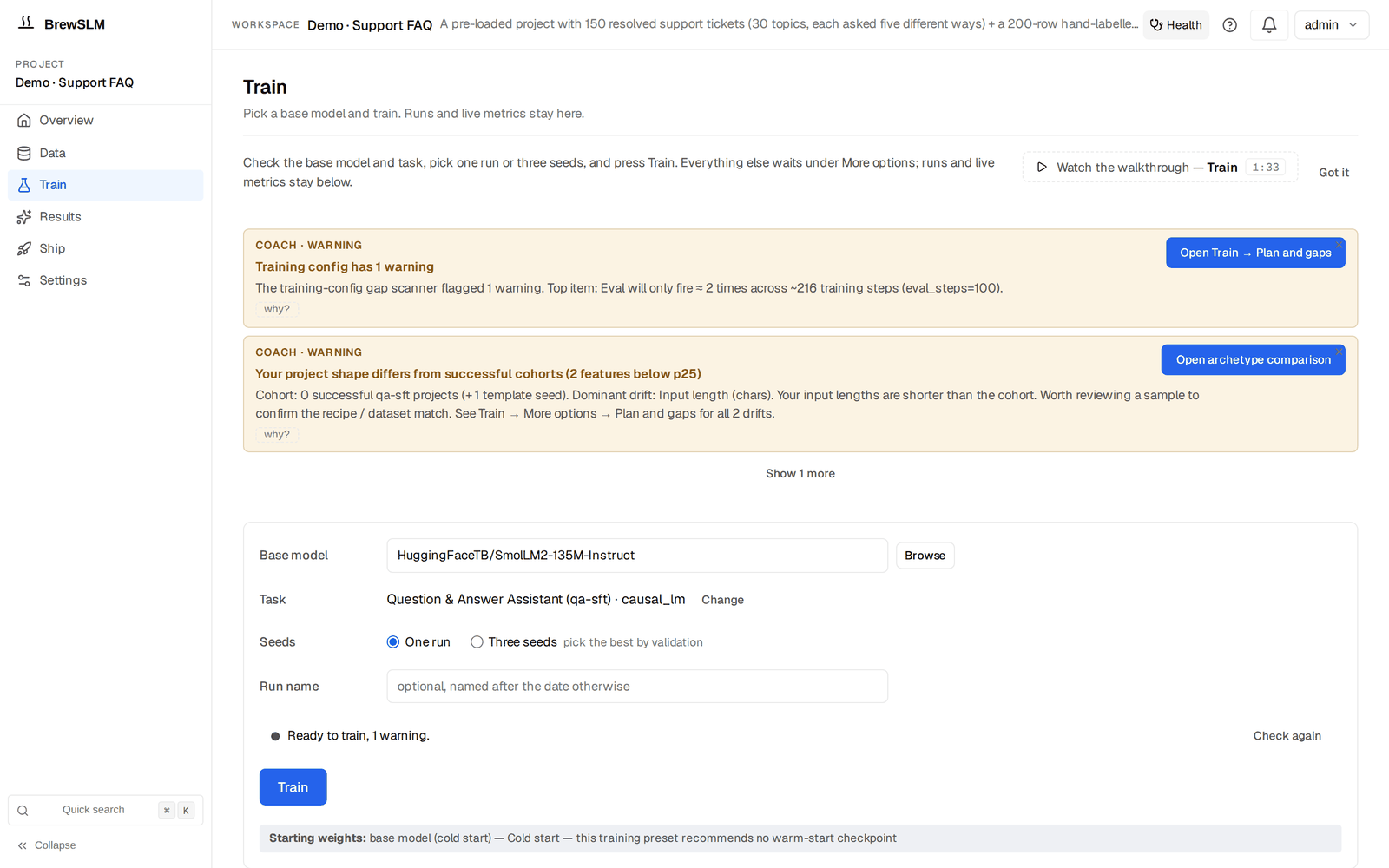
Open Train. It is one form — Base model (+ Browse), Task, Seeds (One run / Three seeds), Run name, a readiness line and the Train button (a confirm dialog shows the resolved config, then Launch). The knobs below live under More options → Model and hyperparameters (epochs, batch size, learning rate, Task Type) and LoRA and advanced training. The recipe defaults are sensible:
- Base model
HuggingFaceTB/SmolLM2-135M-Instruct. The classification head sits on top of the base model's hidden state; the LoRA adapter touches the attention projections. Alternative:distilbert-base-uncasedfor marginally better accuracy at higher latency (encoder-only models are good at classification; the app trains their heads in fp32 and scores them with a head-only eval).- Task Type
- More options → Model and hyperparameters → Task Type = Classification. Two output classes (
injection,benign) are inferred from your rows' label vocabulary. The head is a single dense layer initialised from scratch and trained alongside the LoRA. - Learning rate
- 2e-4 LoRA + 5e-5 classification head. The platform default splits these; the head learns faster because it's initialised from scratch while LoRA fine-tunes a pretrained backbone.
- Epochs
- 5. Classification with 400 gold rows typically needs more epochs than QA SFT — there's less per-example signal so the head needs more passes to converge.
- Batch size
- Batch 8, no accumulation. Classification inputs are short (queries, not paragraphs) so memory isn't the constraint; bigger batches stabilise gradients.
Expected runtime: 3-10 minutes on a single GPU, 10-20 minutes on CPU. Watch the training loss + validation metrics in the run's live dashboard in the runs list under the form; if F1 plateaus below 0.80 by epoch 3, Cancel the run and check the labels — it's almost always a labeling consistency problem, not a model problem.
✓ Checkpoint: on Train, your run's row shows the live loss sparkline trending down and the validation macro-F1 trending up. By the end of epoch 3-4 you should see val macro-F1 ≥ 0.85. When training completes the bell pings, the automatic lift check scores the run, and Results → Verdict shows the summary card ("Accuracy x on the test examples" for an encoder classifier, the lift against the base model otherwise) with the per-class numbers in the scorecard below it.
Read the trainability forecast
Before training, the trainability forecast (Train → More options → Plan and gaps, "Predicted gate-pass: ~N%"; the same number is the predicted_pass row of the goal ledger on Data → Sources → Details → Readiness overview) gives you a forecast based on row count, class balance, and base model size. For SQLi specifically:
- Predicted pass probability ≥ 70%. Lower means your answer key is too thin OR your hard negatives are too similar to each other (low diversity).
- Data ready = met with both classes ≥ 100 rows each. Below that, the model under-fits one class.
- Goal ledger's
gold_setrow at ≥ 100%. The default is 100 answer-key rows; for classification you can go higher (300-400) with diminishing returns past 500.
If the forecast is below 50%, training will pass the basic gates but fail the per-class precision floor on real-world traffic. Spend the extra hour curating hard negatives instead of training. The single biggest predictor of a successful SQLi classifier is the quality of the hard-negative pile, not the training config.
Evaluation with per-class precision floors
After training, the automatic lift check scores the run and Results → Verdict shows the Pass/fail rules card (rule set, PASS/FAIL, the required rules that failed). The classification rule set ships four rules that matter for security classifiers:
- Macro-F1 ≥ 0.85
- Average of per-class F1s. Catches the failure mode where the model is great at the majority class and bad at the minority class — flat accuracy alone won't surface this on a 99/1 split.
- Per-class F1 floor ≥ 0.70
- Every class must hit at least 0.70 F1 individually. For SQLi:
injectionF1 ≥ 0.70 ANDbenignF1 ≥ 0.70 — neither class is allowed to starve. - Benign-class precision ≥ 0.95 (override the default)
- The default classification rule set scores macro F1; for SQLi specifically you want to OVERRIDE the per-class precision floor on the benign class to 0.95+. On Results → Failures, the Scaffolded pass/fail rule set card (shown until you've saved a rule set; afterwards the eval-pack picker on the same tab is the way in) has + Add rule: in the Metric dropdown pick Per-class · benign → Precision (the per-class groups populate from your latest classification eval; if they're empty, run an eval first to discover classes). Set operator
≥, threshold0.95, tick Required, and Save. A model with 0.92 benign precision blocks 8% of legitimate traffic at the false-positive rate — usually unacceptable. - Safety pass rate ≥ 0.93
- Catches refusal / off-topic / adversarial inputs that should be flagged through a different path. Optional gate but useful when you wire the model behind a SOC dashboard.
The scorecard under the Pass/fail rules card on Results → Verdict lists every rule with its value and threshold so you see exactly which class is starving and which rule is failing.
Run the adversarial eval
The 50-row red-team set you curated lives as an external benchmark (Results → Compare → External benchmarks). Score each run on it — Score this run (later Re-score) on its row; the result also shows as a benchmark line on the Verdict card — alongside the test examples, so you read two numbers with different bars:
- Test examples: macro-F1 ≥ 0.85 (the rule set; random split — checks the model isn't overfit to its training rows)
- Adversarial benchmark: macro-F1 ≥ 0.65 (a bar you hold it to by eye — these are intentionally hard; you want to know whether the model generalises, not whether it solves them all)
The two scores in concert tell you different things. High main + low adversarial = the model memorised its training rows. High both = the model generalises. Low main = something is broken in the training pipeline, not the data.
Update the adversarial set quarterly
SQLi tactics evolve. WAF-bypass research publishes new obfuscations every few months. Plan to refresh your adversarial test set 4x a year by adding ~10 rows from recent attack-research write-ups. The training set can stay stable; the adversarial set is your tripwire on novel patterns.
When the eval fails
Common SQLi-specific failure patterns and the fix for each:
| Symptom | Root cause | Fix |
|---|---|---|
| Macro-F1 strong (0.90+), benign precision 0.85 | Hard negatives too easy or too few — model defaults to flagging anything quote-shaped | Add 100+ harder negatives. Mine new ones from your most active form-field columns. Re-run HARD_NEGATIVES playbook with the new seeds. |
| Injection precision 0.95+, injection recall 0.70 | Model is too conservative — misses novel injection variants | Add obfuscated injection examples to the gold set (hex-encoded, comment-spliced, second-order). Run POSITIVES_PARAPHRASE for variant coverage. |
| Both classes < 0.75 F1 | Answer key is too small OR has labeling inconsistency | Sample 50 random answer-key rows; have a second reviewer re-label without seeing the original. Disagreement > 10% = labeling problem. Reconcile and re-train. |
| Adversarial benchmark F1 below 0.50 despite main > 0.85 | Model memorised its training rows; doesn't generalise | Reduce training to fewer epochs; add more diversity to the rows; consider a larger base model. The reroute recommendation on Results → Failures may surface the same "more data, not more training" signal. |
| Per-class precision passes but model flags 5% of production traffic | Train-test distribution mismatch — your test set's benign queries don't reflect production traffic | Capture 1000+ real production queries, label them (10% sample by hand, rest via teacher), re-run eval against this realistic test set BEFORE shipping. |
Ship inline
Three deployment patterns for SQLi classifiers, from least to most risky:
- Shadow mode (recommended first)
- Deploy the classifier; log its verdict on every incoming query; do not act on the verdict. Run for two weeks. Compare flagged queries to what your existing controls (regex / WAF / manual review) caught. Calibrate the threshold based on the precision you actually see on YOUR traffic, not your test set.
- Tee-mode (analyst tooling)
- Surface the classifier's verdict in your SOC dashboard alongside the existing detection chain. Analysts see the small-model opinion as a "second eye"; queries flagged by the model but not by regex go to a review queue. This is high-value with zero false-positive risk.
- Inline blocking (after shadow-mode tuning)
- Wire the classifier as middleware between your application and database. Queries flagged with confidence > 0.85 get blocked; the user sees a generic "input rejected" page. Only do this AFTER shadow mode has proven the false-positive rate on YOUR traffic.
Export on Ship → Package → New export: pick the run, a Format (HuggingFace for the weights — a LoRA run is merged into its base at export; ONNX; Docker, which bundles a serve.py and Dockerfile), quantization and deployment targets, then Run Export. The export appears in the Releases table and under data/projects/<id>/exports/; Ship → Deploy holds the serve / deploy plans for the targets you ticked, and Ship → Publish pushes a HuggingFace export to the Hub. Smoke-test first on Results → Try it (Provider = Trained run (this project); a classifier run replies with the predicted label).
For inline deployment, wrap the exported classifier in a thin HTTP service that fronts your DB layer — POST /classify with the text, back comes the label and its probability; 5-15 ms on a single GPU, 30-80 ms on CPU. The classifier itself does the heavy lifting; your service handles auth, threshold tuning, and the block-or-allow decision.
Defense in depth, not replacement
This classifier is one layer. Keep your parameterised queries, your prepared statements, your principle of least privilege. The classifier catches what gets past the rest; it is not a substitute for the rest. Any deployment plan that turns off existing controls because "the model handles it now" is the deployment plan that ends up on a post-mortem.
What's next
You have a deployed SQLi classifier with calibrated thresholds. Three next moves:
- Active-learning loop from production
- Every shadow-mode disagreement (classifier flags but WAF doesn't, or vice versa) is a high-signal training example. Capture them; have analysts review the disagreements; add the confident-correct ones to the training rows and the answer key. Retrain when the key grows by ~100 rows. Over a quarter, the classifier gets noticeably sharper on your traffic specifically.
- Generalise to adjacent threat classes
- The same recipe + workflow works for: XSS payload detection (binary classifier on user-supplied HTML/JS), command injection (on inputs to shell wrappers), prompt-injection on LLM inputs, abuse-language flagging. New gold set; same training pipeline. The classification recipe is more general-purpose than its name suggests.
- Build a security domain pack
- Package the conventions you've established here — precision floors, rule-set overrides, hard-negative playbook prompts — into a custom
securitydomain pack (Settings → Tools → Domain Packs). Future security classifier projects inherit the conventions instead of re-establishing them each time.
The next tutorial picks a different recipe: invoice field extraction with the span-extraction recipe — structured output, JSON-schema gold sets, and the structured-extraction eval handler's validity diagnostics. Same end-to-end workflow shape; another platform path.
Key terms
- Hard negative
- An input that LOOKS like the target class but is labeled as the OTHER class. For SQLi: a benign query that contains injection-flavoured tokens (quote marks, OR, comments). The single most important data type for a security classifier.
- Per-class precision floor
- A gate that requires precision on every class to meet a minimum threshold individually. Catches the failure mode where the model is great on the common class and silently bad on the rare class.
- Adversarial held-out set
- A small test dataset of intentionally-hard inputs the model NEVER sees during training. Score against this separately to know whether the model generalises beyond its training distribution.
- Shadow mode
- Deployment pattern where the classifier runs in production but its verdict is logged-only, not acted-on. Used to calibrate the threshold and measure real-world false-positive rate before wiring the classifier to block.
- Stratified split
- Train/val/test split that preserves the per-class ratio across all three sets. Essential for imbalanced classification — random split can produce val sets with no minority-class examples.
- Macro-F1
- Average of per-class F1 scores, weighted equally regardless of class size. The headline metric for classification eval; catches class-imbalance bugs that flat accuracy misses.
Check yourself
Answers are saved to this browser.